

This is the point where most website projects get stuck. The design is done, the structure is done, then someone says “we just need the copy” - and nothing happens for weeks.
Not because writing is hard, but because the question is wrong. Instead of “what should I write about myself?”, ask: what does the person who landed here want to find out? Those two are very rarely the same thing.
In this article we walk through how people actually read on the web, which five questions every site must answer, what to write on each page, and the handful of steps that turn a blank page into usable copy in about an hour.
Let's start with the bad news: nobody reads it
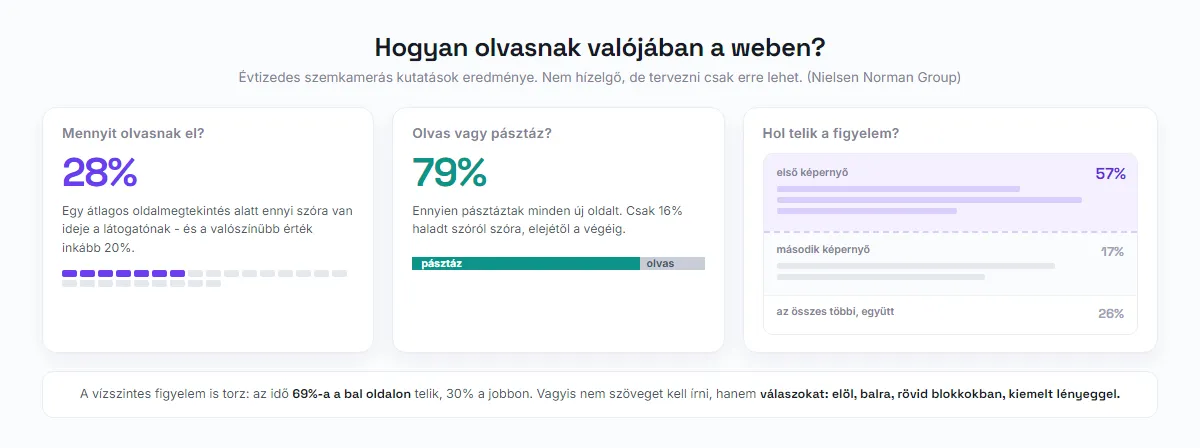
This isn't cynicism, it's measured data. The Nielsen Norman Group, the longest-running research lab in web usability, has been using eye-tracking for decades to see what really happens on a web page.
During an average page visit, a visitor has time for at most 28% of the words, and the more likely figure is closer to 20%. 79% of test participants scanned every new page rather than reading it, and only 16% went word by word.
Where they scan matters too. 57% of viewing time is spent above the fold, the part visible without scrolling. The second screenful gets only 17%. Horizontally, attention leans left: 69% of the time is spent on the left side of the page.
There is only one practical conclusion, but it's a powerful one. Don't write text - write answers, up front, in short blocks, with the key points highlighted. That carefully built, flowing three-paragraph introduction that finally gets to the point at the end simply reaches no one on the web.
The five questions every page must answer
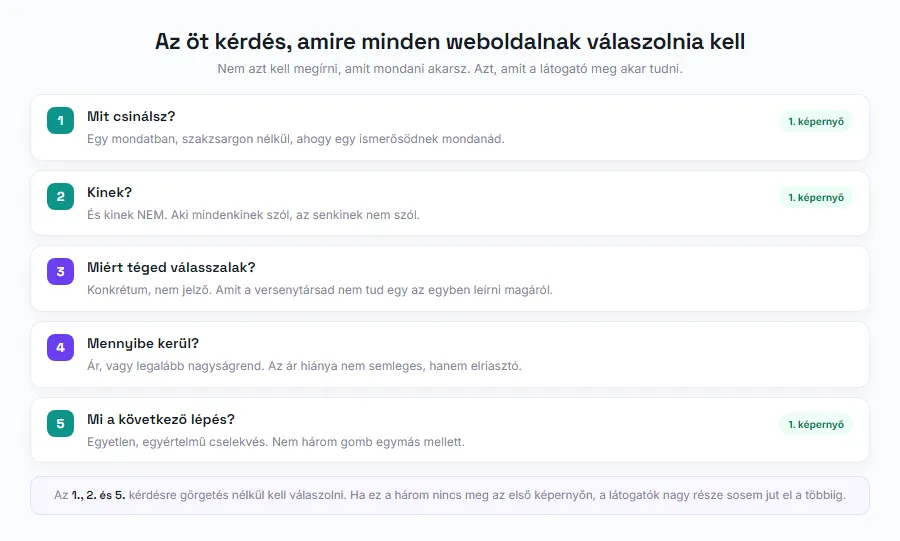
Before you write a single sentence, it's worth knowing what your visitor is looking for. In practice there are five questions, and they are always the same five.
1. What do you do? In one sentence, without jargon, the way you'd say it to a friend. If it takes two sentences, it isn't sharp enough yet.
2. For whom? And just as importantly: for whom not. If you speak to everyone, you speak to no one. “Apartment renovation for families in Budapest” says far more than “interior design”, and it targets better in search too.
3. Why should I choose you? This is where most sites fail, because they write adjectives instead of specifics. We'll come back to this in a moment.
4. How much does it cost? If a fixed price isn't possible, give a ballpark or a starting price. A missing price isn't neutral - it drives people away.
5. What's the next step? One single, unambiguous action. Not three buttons side by side.
Your first screen must answer questions 1, 2 and 5. If those three aren't visible without scrolling, most visitors will never make it to the rest.
Page by page: what goes where?
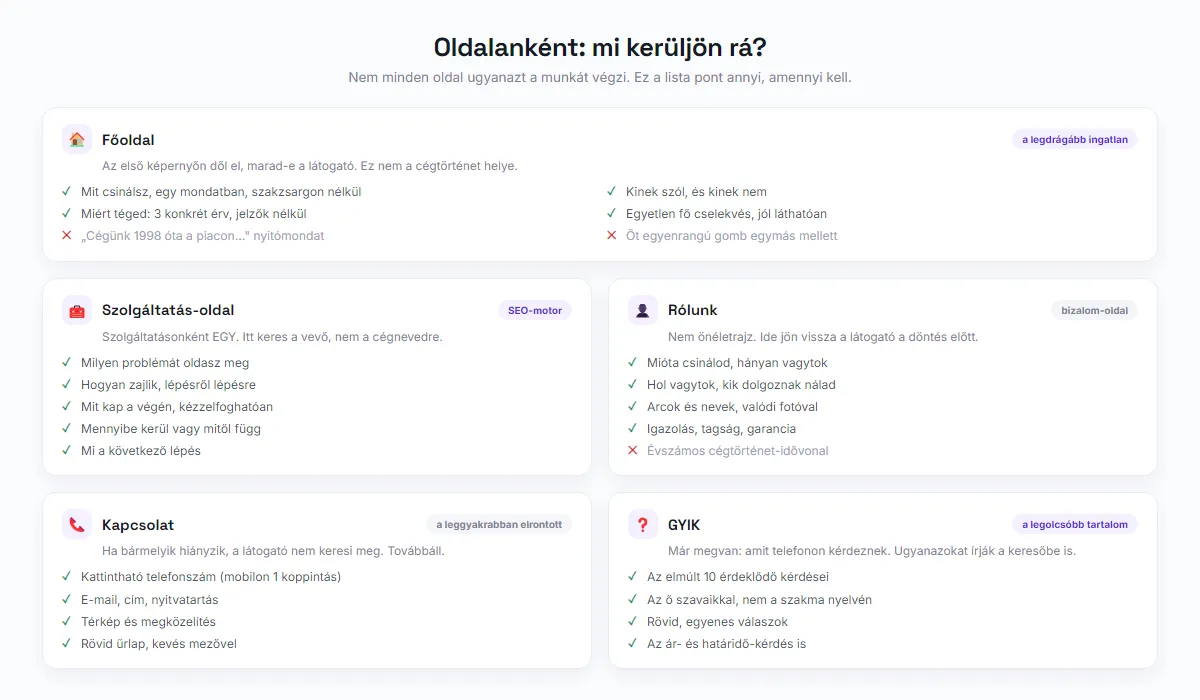
Homepage. What you do, for whom, why you, and one action. This is not the place for company history. The common mistake is opening the homepage with “on the market since 1998”, while the visitor only cares whether you can solve their problem.
Service pages, one per service. This is the most important page type, and the one most often missing from small websites. Each one needs five things: what problem you solve, how the process works, what the client gets at the end, how much it costs, and what the next step is. These are also your most valuable pages for search, because customers don't search for your company - they search for the service.
About. Not a resume - a trust page. Why should a stranger who has never heard of you trust you: how long you've been doing this, how many of you there are, where you are, who works with you. Faces and names. This is the page visitors come back to right before they decide.
Contact. The most frequently botched page. A clickable phone number (one tap to call on mobile), email, address, opening hours, a map, and a short form. If any of these are missing, visitors won't go hunting for them - they'll move on.
FAQ. The cheapest content you can write, because you already have it: exactly the questions people ask you on the phone. Better yet, those sentences match word for word what people type into search engines.
The curse of knowledge: what you think is obvious
There's a mistake almost everyone makes when writing about their own trade. You're so deep in it that you no longer see what the other person doesn't know. You describe things in your industry's language, while your customer calls them something completely different.
A concrete example: the trade says “fenestration replacement”, the customer searches for “window replacement”. The trade says “vehicle diagnostics”, the customer types “why is my check engine light on”. Both mean the same thing, but only one of them gets searched for.
The rule is simple: write the way your customer searches, not the way your industry talks. If you don't know how they search, ask the people who call you. They'll tell you in their own words, and those are exactly the words your site needs.
This is not dumbing down. The professional precision can stay further down the page, in the details. But the first sentence has to speak the language the question arrives in.
Proof instead of adjectives
“Reliable, precise, flexible, customer-focused.” These four words appear on the vast majority of small-business websites, and that's exactly why they mean nothing. No company would ever describe itself as unreliable.
An adjective is a claim; a number is proof. Instead of “fast response”, say “we're on site within 24 hours”. Instead of “years of experience”, say “18 years, more than 400 apartments”. Instead of “competitive prices”, show the actual price or range. Instead of “wide selection”, give the count.
If you don't have a number, you still have proof: a concrete case, a before-and-after photo, a client's name and quote, a guarantee, a certification, a deadline commitment. Anything your competitor can't copy about themselves word for word.
A practical test: read your own sentence and ask whether your competitor could write the exact same thing about themselves. If yes, that sentence isn't doing any work.
Publish your price, or at least a ballpark
This is the most common point of debate, so it's worth clearing up. Behind hidden prices there are usually two fears: that the price will scare customers away, or that a competitor will undercut it.
The problem is that a missing price is not a neutral state. Visitors don't think “I'm sure it'll be a fair price”. They either move on to a site where they can find out, or they assume you're expensive. And most people who are just researching won't spend energy asking for a quote.
If a fixed price really isn't possible because every job is different, there are still options: a starting price (“from 150,000 HUF”), a typical range, a concrete example project with its price, or a short explanation of what the price depends on. Any of these beats nothing.
More on this here: how much does a website cost, where we went through the typical price ranges.
How to start when you're staring at a blank page
The cure for a blank page isn't concentrating harder. It's not treating the task as writing in the first place.
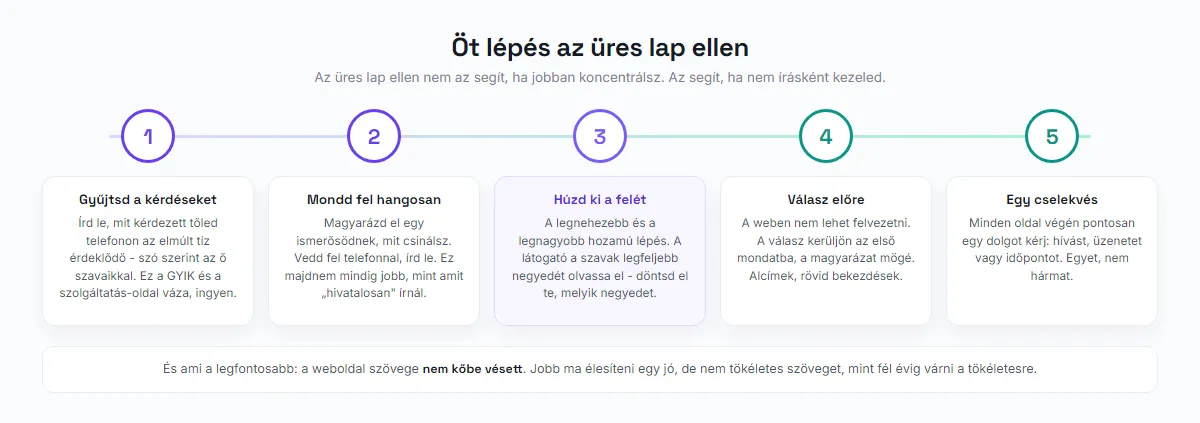
1. Write down what people ask you on the phone. The questions from your last ten enquiries, word for word in their own words. That becomes the skeleton of your FAQ and your service pages, for free.
2. Say out loud what you do. As if you were explaining it to a friend over coffee. Record it on your phone and transcribe it. That recorded sentence is almost always better than what you'd write “officially”, because there's no stiffness in it.
3. Cut half of it. This is the hardest step and the highest-yield one. What remains is the essence.
4. Flip the order. The answer goes first, the explanation after. There's no warming up on the web.
5. End every page with one action. One, not three.
And a reassuring closing thought: website copy isn't carved in stone. It's far better to publish a good-but-imperfect text today than to wait six months for the perfect one. If your site is editable, refining it takes five minutes, and you'll learn more from real visitor data than from any amount of planning anyway.
Frequently asked questions
How much text does a page need?
Can I write my website copy with AI?
Do I need a blog?
What should go on the About page?
Should I really publish my prices?
📚 Sources
Don't want to write copy? You don't have to do it alone.
Our system asks you exactly these questions, step by step, and builds your site's copy and structure from your answers. Afterwards you can rewrite anything yourself, no technical skills needed.
Let's get started →