

A few years ago the question was how to reach the top spot on Google. Today it is increasingly about how to get into the summary the search engine writes above the results, or into the answer ChatGPT gives your customer.
There is a huge amount of noise around this topic. New acronyms have appeared (GEO, AEO), new “AI optimization packages”, and plenty of promises. Meanwhile both Google and OpenAI have published what you do and do not need to do - it is just that nobody likes quoting it, because it is harder to sell.
In this article we start from the official statements and measured data: what has actually changed, how many fewer clicks come with AI answers, what Google literally says about optimization, which bot you are blocking in robots.txt, and the handful of things that truly matter.
What has changed in search?
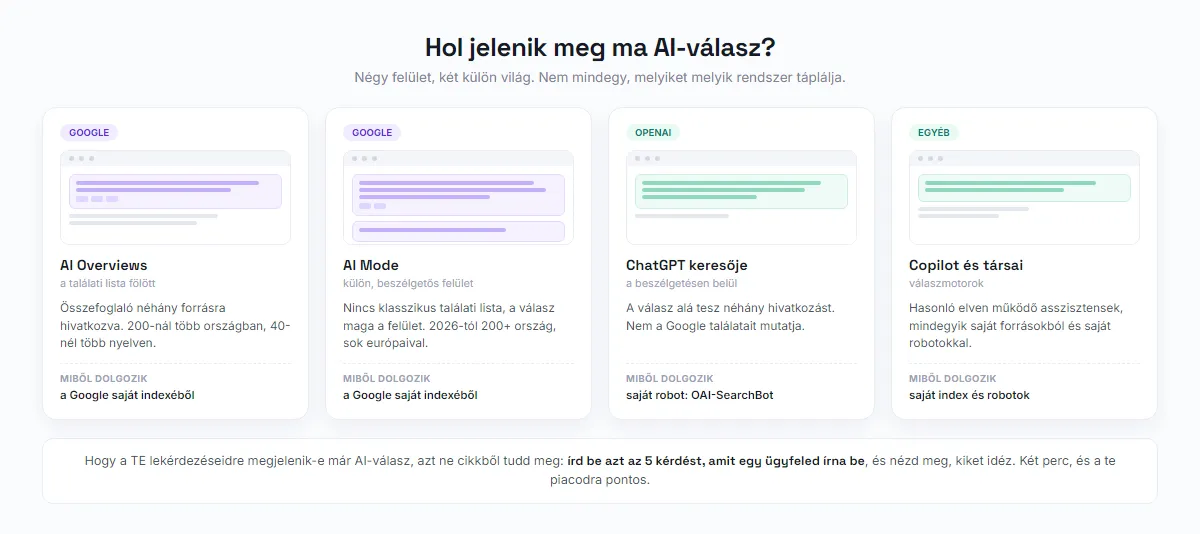
Today there are four different places where someone can get an AI answer to the question that would previously have led them to your website.
AI Overviews: the summary shown at the top of Google's results page. According to Google, since May 2025 it has been available in more than 200 countries and territories, in over 40 languages. AI Mode: Google's separate, conversational search interface, which from January 2026 expanded with more than 35 new languages and 40 new countries, also passing 200, including many European countries.
The third and fourth come from outside the search engines: ChatGPT's built-in search, plus Microsoft Copilot and similar answer engines. These do not show Google results - they work from their own sources and place a few references below the answer.
Whether an AI answer already appears for your specific queries is not something to learn from an article, because it varies by query type and changes constantly. Open the search engine and type in the 3-5 questions a customer of yours would type. It takes two minutes and gives you a more accurate picture than any general claim. You will also see who the AI is citing in your market today.
The bad news: half the clicks
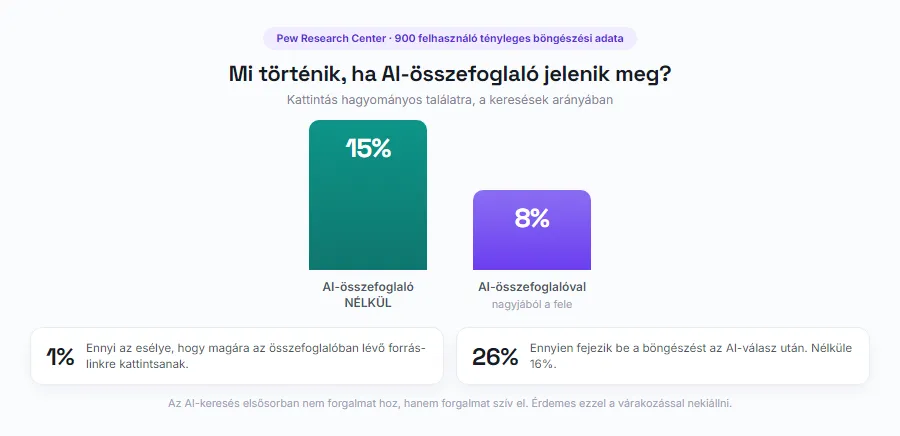
Before anyone sells you AI search as a “new channel”, it is worth looking at the most thorough independent measurement. The Pew Research Center analyzed the actual browsing data of 900 US adults - not a survey: they looked at what people really did.
The result is clear. When an AI summary appeared on the results page, users clicked a traditional result in 8% of searches. When it did not appear, in 15%. Roughly half.
Clicking a source link inside the summary itself was even rarer: 1% of all visits. And users ended their browsing session after an AI summary more often (26%) than without one (16%).
Two things follow from this, and both are better known in advance. First: AI search primarily does not bring traffic - it drains it. Anyone promising that AI optimization will make your visitor numbers jump is either mistaken or selling something. Second: this makes every visitor who still clicks through more valuable, along with simply having your brand mentioned in the answer, even when nobody clicks.
What Google officially says about this
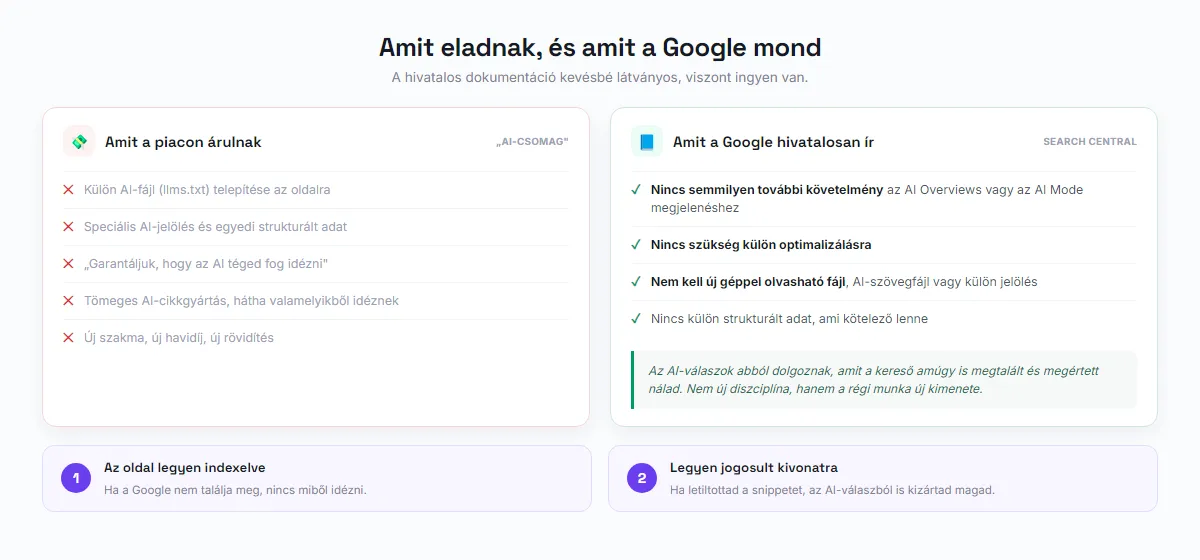
This is the most important section of the article, because it overrides almost everything being sold on the topic. Google Search Central's official documentation on AI features literally says: there are no additional requirements to appear in AI Overviews or AI Mode, and no special optimization is needed either.
The same document gets even more specific: you do not need to create new machine-readable files, “AI text files”, or separate markup to appear in these features. There is no special structured data to add.
There are only two conditions, and both are familiar: your page must be indexed, and it must be eligible for Google to show a snippet from it. If you have blocked snippets somewhere in your headers or robots settings, you have excluded yourself from AI answers too.
In other words, the situation is less spectacular than the industry noise suggests: AI answers work from what the search engine has already found and understood on your site. AI search is not a new discipline - it is a new output of the old work. We wrote separately about that work, meaning today's ranking factors: SEO 2026.
So what actually works?
Even if there is no separate AI optimization, it still matters what a language model finds on your site. There are five things that measurably make it easier to get cited. None of them is a trick - each is a consequence.
1. Question-and-answer structure. A language model can cite you when it finds a clearly delimited answer. An FAQ block and the “heading, then a direct answer below it” structure are exactly that. It is no coincidence that FAQ snippets show up disproportionately often in AI answers.
2. Concrete, verifiable facts. A price, opening hours, a deadline, a service area, a quantity can be quoted. Sentences like “reliable, flexible, customer-focused” cannot, because they say nothing. More on this here: what to write on your website.
3. Clear identifiability. It should be quickly and consistently clear who you are, where you are, and what you do. The same company name, address, and phone number everywhere - on your own site and in your business profiles alike.
4. Freshness and dates. AI answers visibly favor fresh, dated sources. A page not updated in three years gets included less often, even if its content is good.
5. Mentions elsewhere too. The model does not learn about you only from your own site. Industry directories, local listings, press mentions, and reviews all count toward whether it knows you at all.
Which bot are you really blocking?
Here is the most common and most expensive misunderstanding on the topic. Many people have heard that you can “block the AI”, they add a blanket rule to robots.txt, and they do not know what they just switched off.
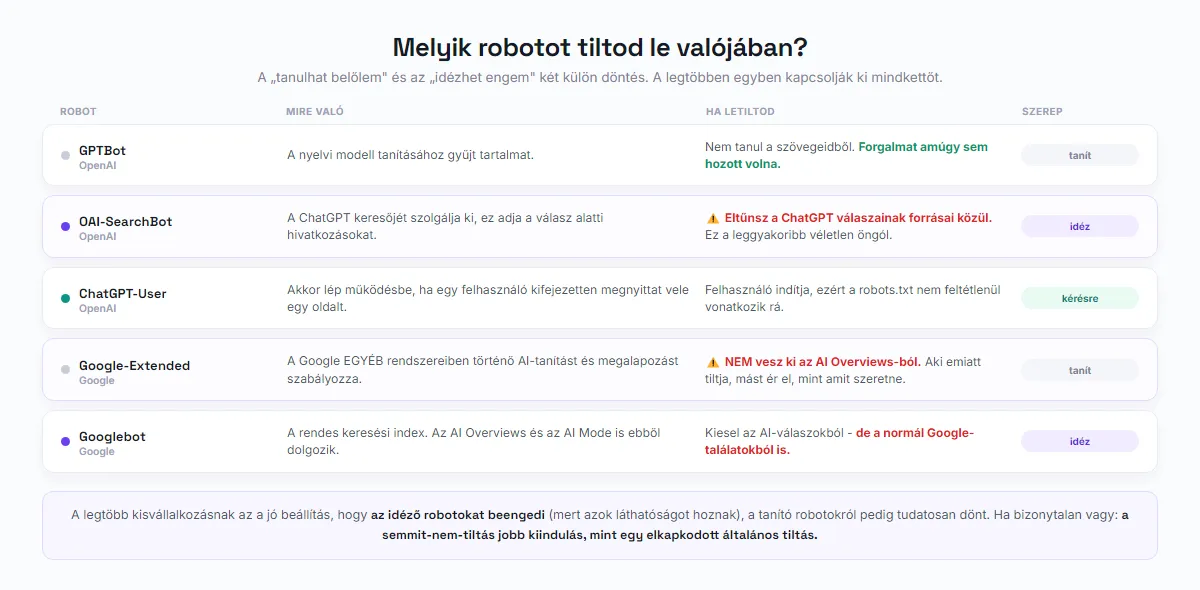
OpenAI uses three different bots, and each can be controlled separately. GPTBot collects content for training the model: if you block it, it will not learn from your texts, but it would not have brought you traffic anyway. OAI-SearchBot, however, serves ChatGPT's search and provides the citations: block it and you disappear from the sources of ChatGPT's answers. The third is ChatGPT-User, which kicks in when a user explicitly asks ChatGPT to open a page.
On Google's side the situation is similar, just under different names. Google-Extended, in Google's own wording, is for limiting AI training and grounding in its other systems - not for switching off AI Overviews and AI Mode. You can stay out of AI Overviews using the usual Googlebot and snippet controls, but those also cut off your normal search appearance.
The practical lesson is simple: “it may learn from me” and “it may cite me” are two separate decisions. For most small businesses the right setup is to let the citing bots in (because that brings visibility) and to make a conscious choice about the training bots. If you are unsure, blocking nothing is a better starting point than a hasty blanket ban.
What does this mean for a small business in Hungary?
First, proportions. If you are a local service provider, most of your visitors are not asking analytical questions - they want to know who can do the job, by when, and for how much. For these questions the AI answer is typically short and highlights very concrete data.
That is why the best investment is not some new AI technique but the old, boring basics: publish your price or at least your price range, your exact service area, your opening hours, your response time. These are the quotable sentences.
Second, the backbone of local visibility is still your Google Business Profile, because for local questions AI answers draw on that data set too. If your profile is incomplete or outdated, no amount of text optimization will fix that.
The third is a matter of mindset. Since AI summaries reduce clicks, every channel with a direct relationship gains value: the returning customer, the referral, the newsletter, the phone number. In the AI era, the vulnerable business is the one built solely on anonymous traffic from search.
What not to spend on
Hastily assembled offers always appear around new technologies. There are four you see most often today, and it is worth knowing what they are worth.
A separate “AI file” for your site. Google's documentation explicitly states that you do not need to create any new machine-readable file or AI text file to appear in these features. If someone charges you for this, they are selling something the provider itself says is unnecessary.
Guaranteed AI citations. Same category as a guaranteed first place on Google: it cannot be guaranteed, because it is not your provider who decides.
Mass-produced AI content. The “let's churn out two hundred articles and hope one gets cited” strategy runs into the search engines' spam policies, and the rule does not depend on whether a human or a machine wrote the text - it depends on whether valueless content is being produced at scale.
Blind bot blocking. As we saw above, it is easy to “block the AI” in a way that locks out exactly the citing bot.
What to do next week
Four steps that take a few hours in total, each following from the official recommendations.
First, take stock. Type the five questions a customer of yours would ask into the search engine and into ChatGPT, and note who the answers cite. That is your starting point.
Second, check whether you are quotable at all. Your site must be indexed and must not carry a snippet ban. You can check this in Search Console, for free.
Third, review your robots.txt. If it contains rules for AI bots, decide consciously which should stay: the training one or the citing one.
Fourth, write quotable sentences. Expand your FAQ with the questions you get on the phone, and put concrete numbers into the answers. This is the work that pays off in AI answers and in traditional results alike, and it will not go to waste even if everything changes again next year.
Frequently asked questions
What is an AI Overview?
Is AI search available in Hungarian too?
Do I need llms.txt or another AI file on my site?
Should I block AI bots in robots.txt?
Is AI killing SEO?
📚 Sources
- Google Search Central: AI features and your website (the official position on optimization)
- Google: AI Overviews in more than 200 countries and over 40 languages (May 2025)
- Google: AI Mode language and country expansion
- Pew Research Center: Google users are less likely to click on links when an AI summary appears
- OpenAI: overview of OpenAI's bots (GPTBot, OAI-SearchBot, ChatGPT-User)
Let's see whether your site is even quotable
Our free SEO analyzer checks whether your site can be indexed, whether it carries a snippet ban, whether its structure is in order, and gives you a score with concrete to-dos. These are the same fundamentals AI answers work from.
Start free analysis →