
“Why would I need a website? I have my Facebook page, and it's free.” We hear this from almost every small business owner - and there is truth in it: 5.65 million people use Facebook in Hungary, so your customers really are there. The question is not whether you need a Facebook page. It's whether it is enough on its own, if you build your entire online presence on it.
In this article we take an honest look at what a Facebook page is good for and where its limits are, what your own website can do instead (more precisely: alongside it), and why the setup that really works is the one where the two don't compete but work for each other.
Why does a Facebook page seem like enough?
Three strong arguments speak for a Facebook page: it's free, it's familiar, and it works right away. You can create one in five minutes, you need no domain and no developer, and you've been using the platform as a private person for years. Your friends like your posts, sometimes they message you - it feels like you have everything covered.
A website, by contrast, looks like “a hassle”: you need a domain, hosting, someone to build it. (That picture is outdated, by the way - with us, the first version is built from a single conversation within hours - but the reflex is understandable.) So many businesses stop at the Facebook page and never notice what they are losing. Let's look at the numbers.
What is a Facebook page good for? Honestly: quite a lot
Let's start with the positives, because this is not an anti-Facebook article. A Facebook page is great for being present where people spend their time: you share quick news (changed opening hours, a new product, a promotion), you show photos of your work, and through comments and messages you stay in direct contact with your customers. Reviews and reactions provide social proof.
And it has one more big strength: its advertising system. With Meta ads you can target precisely by age, location and interests - and this works even when few people see your page organically. On how to advertise so that clicks turn into actual clients, we have a separate article: Facebook ads for beginners.
So the problem is not that Facebook is a bad tool. The problem is that as your only tool, it is not enough - and the reasons are very concrete and measurable.
Where are its limits? Three reasons you can measure
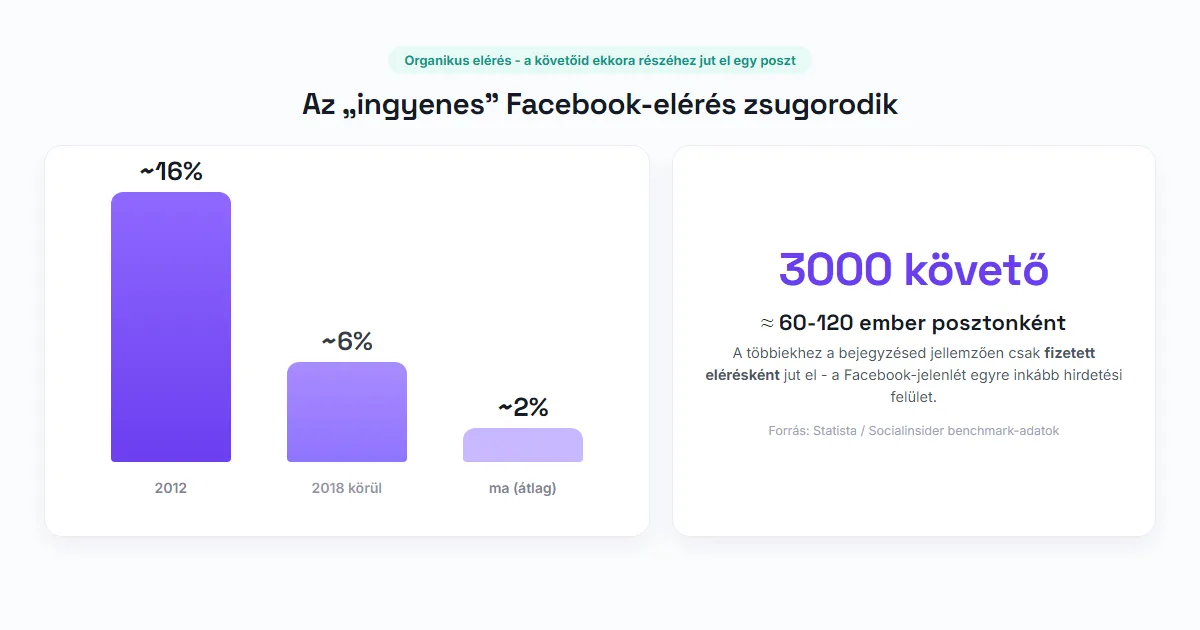
1. Your posts reach only a fraction of your followers. In 2012, a page post still reached roughly 16% of followers organically. Today, measurements show a reach of 2-6%, around 2% on average. In other words, if you have 3000 followers, a post of yours is typically seen by 60-120 people - the rest can only be reached as paid reach. The “free” Facebook presence is, in reality, increasingly an advertising platform.
2. The page is not yours. Your Facebook page lives on Meta's platform, under Meta's rules: the algorithm changes unilaterally, the page can be blocked or hacked - business pages get hijacked every day - and when that happens, the entire audience you built becomes unreachable overnight. Your own website and a domain registered in your own name, by contrast, are your property: nobody can switch them off over your head.
3. Your customers search on Google. When someone needs a hairdresser, an accountant or a plumber, they don't scroll through Facebook - they search. In those searches, a website and a Google Business Profile rank - Facebook pages typically show up far down in Google results or not at all, and your posts are practically invisible to the search engine. With a Facebook page you talk to the audience you already have; with a website, you get found by people who don't know you yet.
What can your own website do that a Facebook page can't?
Your own website is not a “digital business card” - it is the one online presence of your business that is fully under your control: you decide how it looks, what matters on it, and what the visitor should do. There is no algorithm between you and the person who is interested.
What exactly to put on it is covered in a separate article (what should I write on my website?) - here, the capabilities are what matter:
- You can be found on Google: a search-optimized site shows up even for people who have never heard of you - unlike Facebook, this brings new customers instead of only reaching existing ones.
- Your own address, your own branding: a domain registered in your name and a unique look build trust - you're not “one of many” inside a platform's template.
- It wins clients, not just likes: a form, appointment booking, a price list, even a webshop - visitors turn into concrete inquiries.
- It's measurable: with Google Analytics and Search Console you can see exactly where visitors come from and what works - that's what our Analytics guide is about.
- It doesn't depend on anyone's goodwill: no bans, no algorithm changes, no vanishing reach.
The right setup: the website is the hub, Facebook is a channel
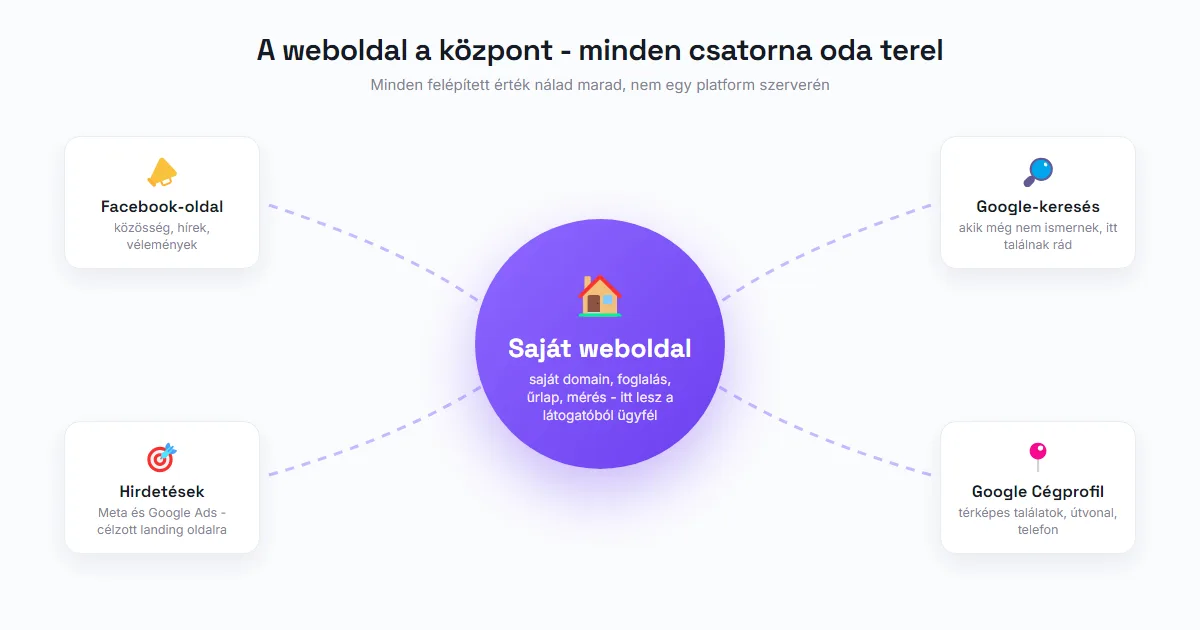
So the answer to the question is not “a website instead of Facebook”, but this: the website is the hub, and every other channel drives traffic to it. Your Facebook post points to the article, price list or booking page on your website. Your ad takes people not to your page but to a targeted landing page - as we wrote in our ads article, a campaign is won or lost by where the click lands. Your Google Business Profile links to your website, and that's where the search engine gets its information.
In this setup, every channel does what it is best at: Facebook brings attention and community, Google brings searchers, and the website turns them into clients - and every bit of value you build stays with you, not on a platform's server. If a new social platform appears tomorrow, you simply plug it in as a new spoke; the hub doesn't change.
How to get started if today you only have a Facebook page
The good news: the Facebook presence you built is not wasted - it becomes your starting capital, and your followers will be your first visitors. The order is simple:
- Get your own website with your own domain - with us it starts with a conversation, and the first version is ready within hours.
- Connect your presence: put your site's address in your Facebook page's “Website” field and in your posts, and make your Google Business Profile point to it as well.
- Move the important actions over: appointment booking, price list and quote requests should live on the website - Facebook is where you announce them.
- Measure: set up Analytics and Search Console so you can see which channel brings actual leads.
Frequently asked questions
A Facebook page is free - why is a website still worth it?
Should I delete my Facebook page once I have a website?
My Facebook page shows up on Google when people search for my business name. Isn't that enough?
What happens to my Facebook followers if I shift the focus to a website?
📚 Sources
Get a hub of your own
Describe in a few sentences what you do - our system builds the first version of your website within hours, with your own domain and your own branding. And your Facebook page can finally do what it does best: send your audience there.
Let's build your site →