

This is one of the most common questions we hear from small business owners: “should I pay Google for ads, or invest in search engine optimization instead?” The bad news: anyone promising a single simple answer is usually trying to sell you something. The good news: the logic behind the decision can be understood in a few minutes, and after that you can judge for yourself which one pays off in your situation.
In this article we clear up the real difference between the two, when each brings more customers, what their cost structures look like, and we bust a few stubborn myths - such as the one that says ads “boost” your organic ranking. If you want to dig deeper into either topic, check out our Google Ads guide and our SEO 2026 article.
What is the actual difference?
The Google results page consists of two sharply separated parts. Ads (Google Ads) appear at the top of the list with a “Sponsored” label: they are there because someone pays for every click. The organic results line up below them: those cannot be bought - Google ranks them by how well they answer the search, and that ranking is what search engine optimization (SEO) improves.
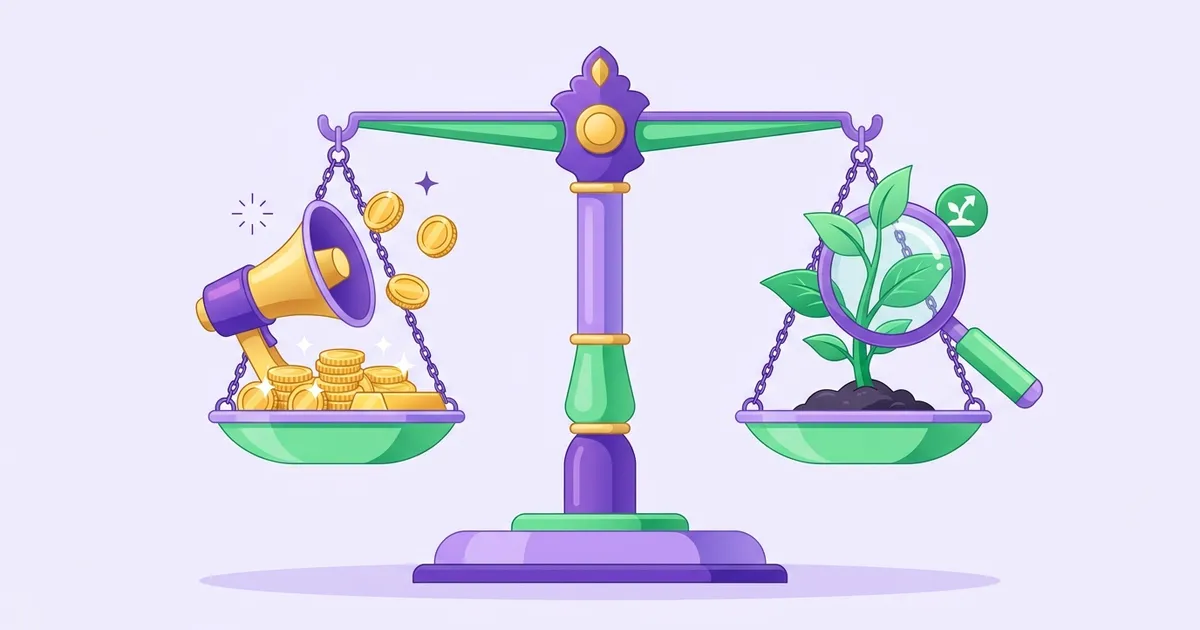
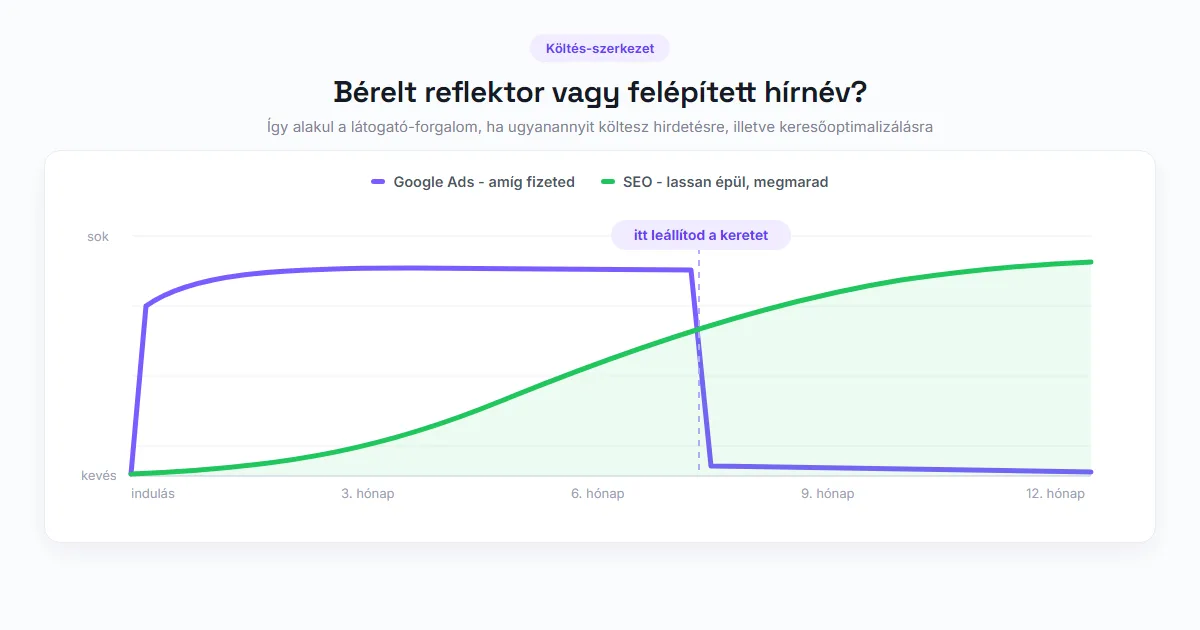
The simplest picture: Google Ads is a rented spotlight, SEO is a built-up reputation. The spotlight shines the moment you switch it on and goes dark the moment you stop paying. Reputation builds slowly, but it keeps working for you even when you are not spending - a well-ranking page brings visitors “for free” for months or even years.
One important thing they share: both bring customers only if the click lands on a convincing, fast, mobile-friendly website. The weakest link is often not the ad or the ranking but the site itself - that is what our page speed article is about.
When is Google Ads the right choice?
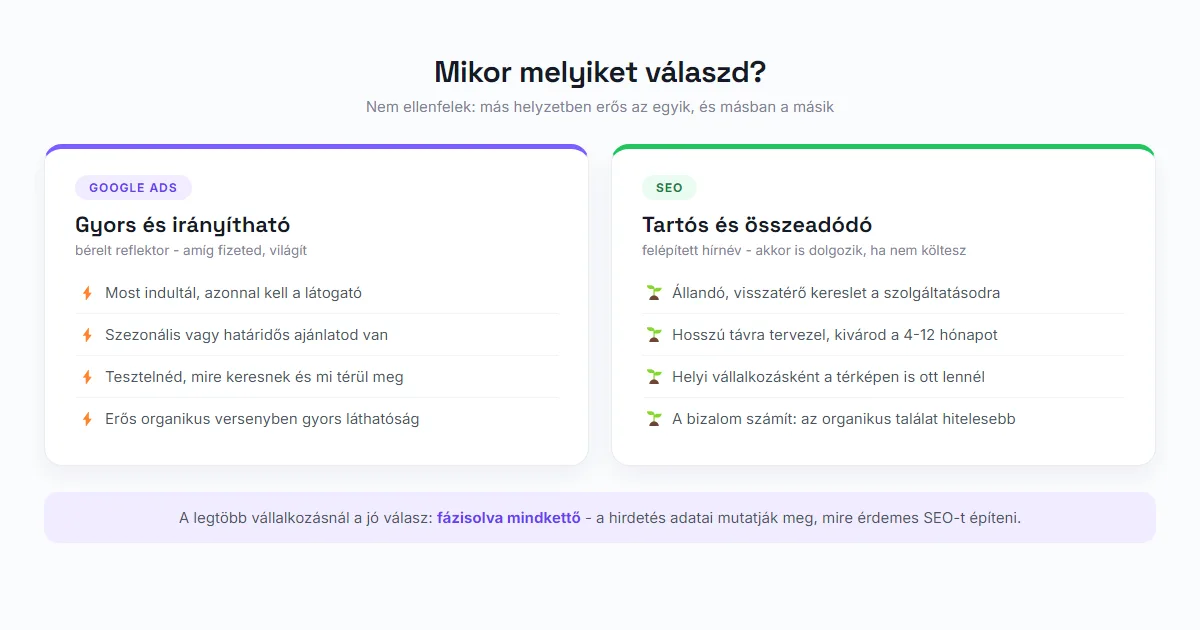
The greatest strengths of advertising are speed and control: you set it up today, and tomorrow you already appear in first place for the search you picked. You decide exactly what you show up for, where, and at what cost, and you can stop it at any time. That is why there are situations where Google Ads is simply unbeatable.
The price is nothing to fear either: you can make a meaningful start with a budget of a few hundred forints a day, as we showed in detail in our beginner’s Ads guide - the key is to target narrowly and measure what happens after the click.
- Your business or website has just launched: SEO needs months, while ads bring visitors right away.
- You have a seasonal or deadline-bound offer (Christmas, back to school, a sale): there is no time for organic growth.
- You want to test what people search for and what pays off before committing to a long-term investment.
- You are targeting a keyword where the organic competition is very strong and you realistically cannot reach the top any time soon.
When is SEO the right choice?
Search engine optimization wins when there is lasting, recurring demand for what you offer. A hair salon, an accountant, or a plumber gets searched for every month - whoever ranks high organically for those searches keeps winning business from them for years, with no per-click bill.
The returns of SEO add up: every good piece of content and every technical fix builds on what is already there. That is also its drawback: it takes time. According to Google’s own official guidance, the impact of changes typically shows up between 4 months and 1 year - if someone promises “first place in two weeks”, run.
For a local business, the fastest-paying piece of SEO is not even on your website: setting up your Google Business Profile properly is free and makes you instantly visible in the map results.
- Demand for your service is constant, not campaign-driven.
- You are planning long term: what you invest now keeps producing for years.
- You run a local business: Business Profile plus website gets you into the map results too.
- Trust matters in your field: a significant share of searchers find organic results more credible than ads.
How much does each of them cost?
The two cost structures are fundamentally different. Google Ads is an ongoing operating cost: you pay for every click, and as soon as you stop the budget, the traffic disappears too. SEO is more like an investment: you pay upfront (for content, technical fixes, or even just your own working hours), and in return the traffic builds up gradually and does not vanish the moment you stop spending.
That is why “which one is cheaper?” is a misleading question. In the short term, Ads almost always brings customers more cheaply, because it targets instantly. In the long term, SEO almost always wins, because the hundredth customer no longer costs another click fee. The real question is over what time horizon you need to show results, and whether you have the patience (and the reserves) to wait out the organic ramp-up.
In most cases the right answer is: both, in phases
In practice, the answer to the “either-or” question is usually “both” - just not at the same time, but in phases. At launch, ads give you fast feedback: you see what people search for, which keyword brings real prospects, and what pays off. Those lessons let you build SEO with precision: you write content for exactly the searches your ad data has proven to bring customers. As your organic rankings build up, you can gradually scale the ad budget back or shift it to a new area.
There is also a fresh market argument for “both”: measurements show paid results taking an ever larger slice of the clicks. A 2026 study found that in the product categories examined, the classic organic click share fell by 11-23 percentage points in a single year while the paid share roughly doubled - yet organic still delivers the majority of clicks. In other words: do not bet everything on either leg.
And since search itself is changing - AI overviews answer more and more questions without a single click - the third leg of visibility is getting your content to appear as a source in AI answers. We have a separate article on that: how to get into AI answers.
Myths that burn a lot of money
“If I advertise, Google will rank me higher in the organic results too.” No. Google states officially and unambiguously: ad spend does not influence organic ranking in any way - neither positively nor negatively. The two systems are deliberately kept separate. Anyone selling you an “organic boost combined with ads” is misleading you.
“SEO is a one-off job: we do it once and we are done.” SEO needs maintenance: your competitors keep working, Google’s algorithm changes, content goes stale. You do not have to touch it every week, but the promise of “set it once and it lasts forever” is simply not true.
“Ads are money down the drain - everyone skips them anyway.” The numbers say otherwise: the share of searchers who click paid results grows year after year, and the vast majority never even reach the second results page. Ads are wasted money only when they run on the wrong keyword, to the wrong page, with no measurement - and that is not the channel’s fault.
Frequently asked questions
How much money do I need to start with Google Ads?
How long does SEO take to show results?
Is it true that advertising improves organic rankings?
I have a small budget. Which one should I start with?
📚 Sources
See where your website stands right now
Before you spend on ads or SEO, get a free assessment of how well your website holds up: our analyzer scores it on 17 criteria and shows you what to improve first.
Start your free SEO check →